
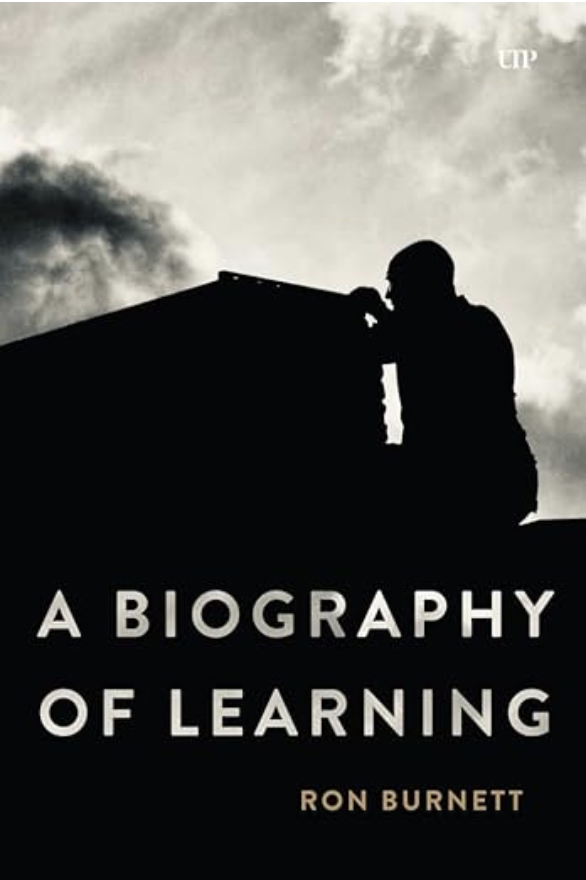
A Biography of Learning University of Toronto Press (2025)
Abstract:
A Biography of Learning explores the history and effectiveness of learning within formal educational practices and details the impact of current technologies on the teaching and learning experience.
Ron Burnett offers a timely and provocative vision for educational transformation. Drawing on his decades-long career as both an educator and institutional leader, Burnett crafts a compelling narrative that bridges personal experience with forward-thinking educational theory and practice.
This book suggests that transformative learning demands time - far more than our rapid-fire systems allow us. It challenges our obsession with quick inputs and outputs, exposing the deeper, slower rhythms of authentic intellectual growth, and forges powerful connections between physical learning spaces, creative environments, and the frontiers of experimentation where teaching and learning boundaries are dramatically expanded.
A Biography of Learning emerges at a critical juncture, where technological revolution meets institutional evolution.
Burnett's approach is refreshingly pragmatic yet boldly visionary, providing roadmaps for tomorrow. For anyone invested in the future of learning - educators, administrators, policymakers, students, and engaged citizens - Burnett's insights provide inspiration for navigating the intersection of tradition and innovation in educational practices.

Heinz Inlander, Il Pittore Perduto: Un memoriale immaginario Davide Ghaleb Editore (2025)
Abstract:
Heinz Inlander, a young man fleeing Vienna, reaches London with his family shortly before the annexation of Austria by Nazi Germany in the late 1930s and the start of World War II.
The author uses layered prose, creating an interplay between narrative, fiction, and reflection to tell the story of Inlander's evolution from a young refugee to a renowned painter in the 1950s and 1960s.
The reader is offered an intimate story of war and loss, told through the story of an artist who spent the rest of his life in Italy and England.
How Images Think MIT Press (2005)
Excerpt:
“Throughout this book reference is made either directly or indirectly to debates about perception, mind, consciousness, and the role of images and culture in forming and shaping how humans interact with the world around them. As more knowledge is gained about the human mind, embodied and holistic, the role of culture and images has changed. Images are no longer just representations or interpreters of human actions. They have become central to every activity that connects humans to each other and to technology—mediators, progenitors, interfaces—as much reference points for information and knowledge as visualizations of human creativity. However, the relationship between human beings and the cultural artifacts they use and create is by no means direct or transparent. Human consciousness is not passive or simply a product of the cultural, social, or political context within which humans live and struggle. Although the cognitive sciences have dreamed of developing a clearer picture of how the mind operates and although there have been tremendous advances in understanding human thought, the human mind remains not only difficult to understand but relatively opaque in the information that can be gathered from it (Searle 1998, 83). Notwithstanding numerous efforts to “picture” and “decode” the ways in which the mind operates, profound questions remain about the relationships among mind, body, and brain and how all of the elements of consciousness interact with a variety of cultural and social environments and artifacts. How Images Think explores the rich intersections of image creation, production,and communication within this context of debate about the mind and human consciousness.”

Cultures of Vision Indiana University Press (1995)
Excerpt:
“Often, to speak of photographic images, is to say, “there was my mother,” or “I looked beautiful as a child.” The plasticity and the physicality of the image collapses. Distinctions between memory and sight and photographic print temporarily melt into each other. This entanglement is cultural and is also representative of a history (histories) of desire, a history which links the invention of photography to the legitimation of the image as a tool of communication and which prioritizes directness, the explicit, the transparent, as formless expressions of truth. This is also one of the roots of the nostalgia which haunts relations between family imagery, photography and memory. As the plasticity of the photograph recedes into the background its transitory nature becomes more and more important. It takes an act of will to keep all of these connections from simply splaying off into many different directions. Because of this photographs are always in transition and at the same time they are held in tow — this process, this tension is partly the result of the manner in which photographs come from the past but must be converted into the present. There is an artifice to this activity which transforms the plasticity of the photographic image into a representation which need have little connection to the original experience from which the photograph has been drawn.”
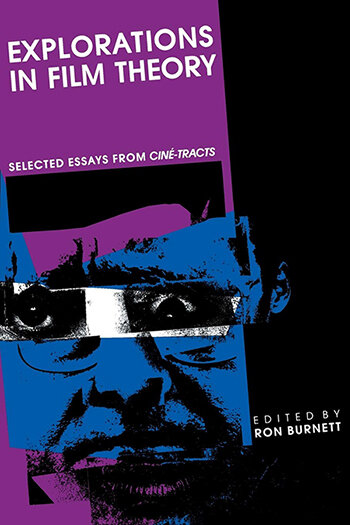
Explorations in Film Theory: Selected Essays from Ciné-Tracts Indiana University Press (1991)
Excerpt:
“CINE-TRACTS began in 1976 with a burst of creative and collective activity. The idea of starting a Canadian based film journal was largely the work of four people and in some respects CINE-TRACTS could not have been created without the bonds of friendship, the emotional, philosophical and ideological ties which are the foundation upon which projects like CINE-TRACTS are built. More than just a magazine CINE-TRACTS was a project because we originally saw the journal as a tool for political debate, a context where a community of scholars, filmmakers and students could engage in a praxis somewhat alien to Canadian cultural life.”